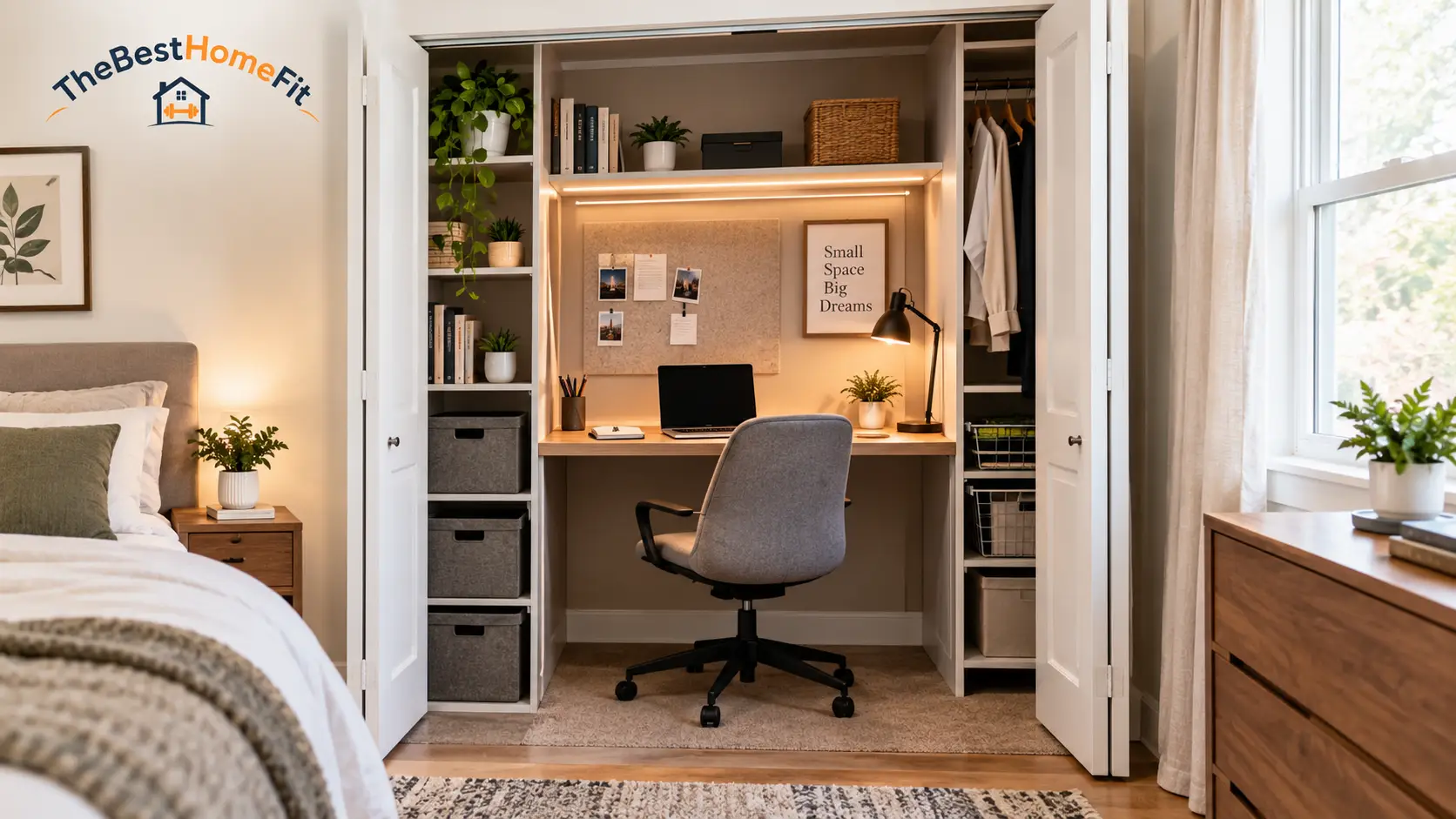
Finding room for a home office can be difficult when your bedroom is already doing more than one job. Adding a full-size desk beside the bed may make the room feel crowded, while working from the bed or dining table is rarely comfortable for long.
That is where a bedroom closet office can make a surprising difference.
Often called a cloffice, this setup turns all or part of an existing closet into a compact workspace. A simple shelf can become a desk, upper walls can provide storage, and the closet doors can even hide your work area at the end of the day.
Whether you have a tiny reach-in closet, a large wardrobe, or a walk-in closet with room to spare, there are plenty of ways to create a workspace that feels practical rather than squeezed in.
Below are 21 bedroom closet office ideas, followed by planning, storage, lighting, ergonomic, budget, and DIY tips to help you create one that actually works.
What Is a Bedroom Closet Office?
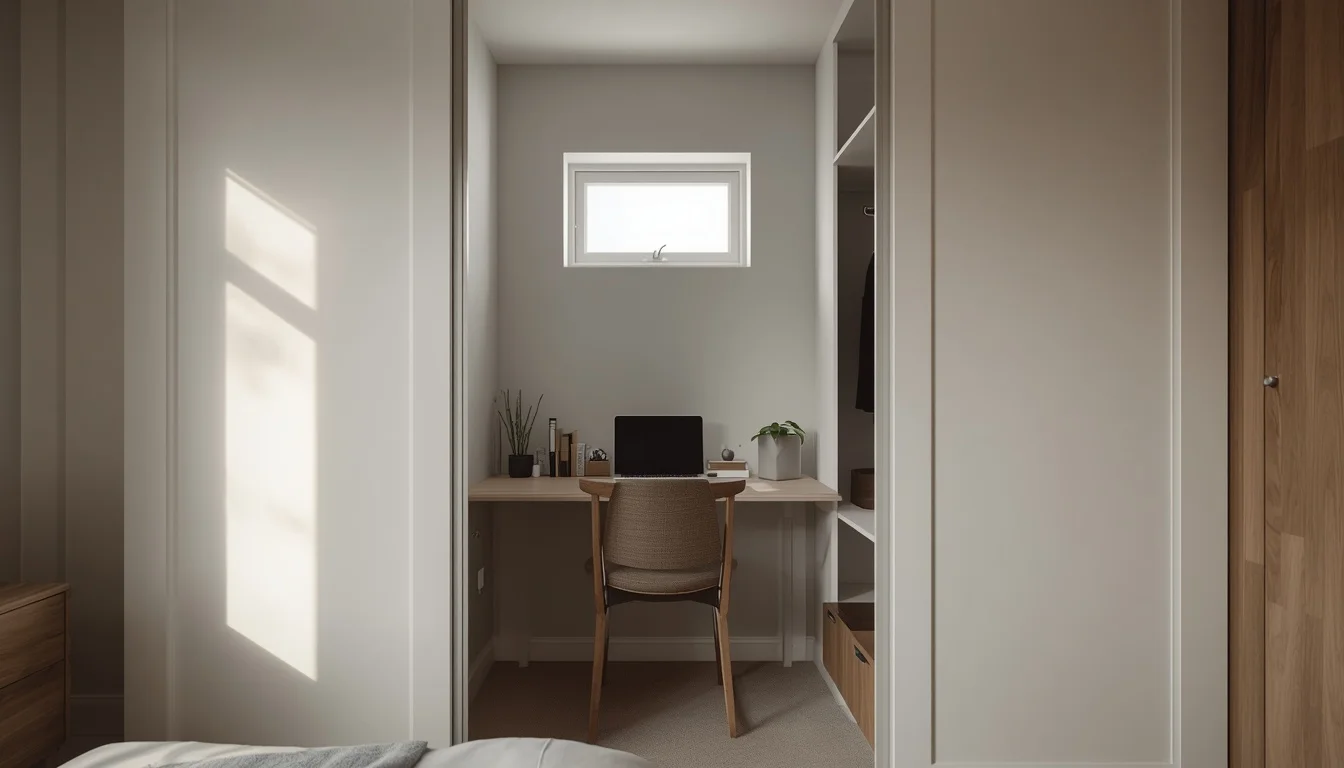
A bedroom closet office is a workspace created inside an existing closet or wardrobe. Instead of using the entire area for clothes and storage, part or all of the space is converted into a desk area.
The idea is especially useful in:
- Small bedrooms
- Apartments
- Guest rooms
- Studio apartments
- Shared homes
- Bedrooms without space for a freestanding desk
- Homes without a dedicated office
Some closet offices are permanent built-ins with cabinetry and lighting. Others are simple DIY setups made with a shelf, a compact chair, and a few storage baskets.
You may also see the idea described as a cloffice, closet home office, wardrobe office, built-in wardrobe desk, or office in a closet.
What to Consider Before Turning a Bedroom Closet Into an Office
A good-looking setup is not enough. Your closet also needs to be comfortable enough to use for several hours at a time.
Before removing shelves or buying a desk, look at the space carefully.
Measure the Closet First
Measure the:
- Interior width
- Interior depth
- Floor-to-ceiling height
- Door opening
- Available legroom
- Space needed for your chair
- Distance between the desk and any shelves above it
Also check whether the chair can move back far enough for you to sit comfortably.
If you want the office to disappear behind closed doors, confirm that the chair, monitor, desk accessories, and lighting will all fit inside when the doors are shut.
Check Your Electrical Access
Look for nearby power outlets before building anything.
You may need power for:
- Laptop chargers
- Monitors
- Desk lamps
- Phone chargers
- Speakers
- Printers
- USB hubs
- Small fans
Avoid creating a setup where extension cords have to run awkwardly across the bedroom floor.
Think About Lighting
Many closets receive little or no natural light. Overhead bedroom lighting may also leave the desk in shadow.
Plan your lighting at the beginning rather than treating it as decoration later.
Decide How Much Closet Storage You Can Lose
You do not always have to sacrifice the entire closet.
In a wide wardrobe or walk-in closet, clothing can stay on one side while the other side becomes a workspace. Upper shelves can also remain available for seasonal clothing and storage boxes.
Consider Airflow
A closet can become warmer than the rest of the bedroom once a laptop, monitor, lighting, and other electronics are running.
If the closet is enclosed, think about airflow before committing to the design.
21 Bedroom Closet Office Ideas
1. Turn a Reach-In Closet Into a Compact Office
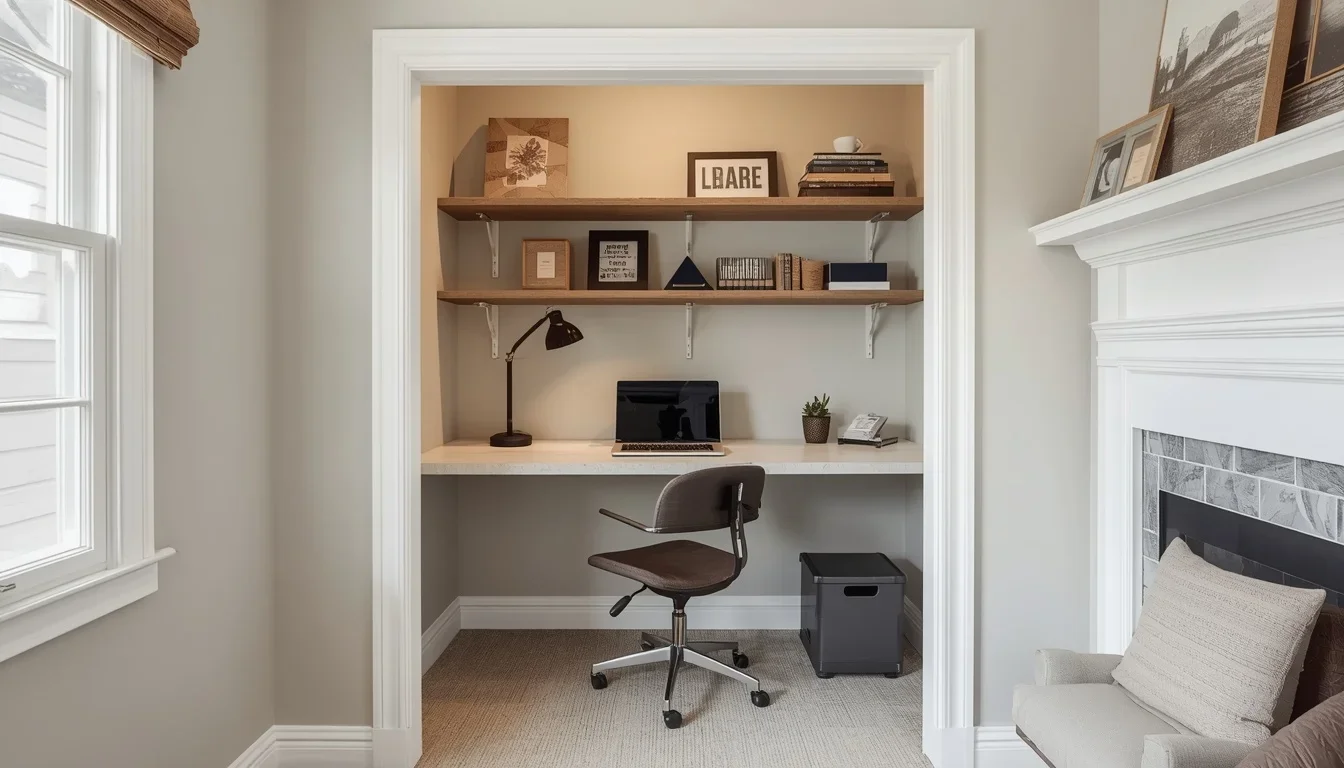
A standard reach-in closet is one of the easiest spaces to convert.
Remove the clothing rod, install a desk across the width, and use the wall above it for shelving.
This works particularly well for laptop users who do not need a large amount of equipment.
For a cleaner appearance, choose a desk surface that stretches from wall to wall rather than placing a small freestanding desk in the middle.
2. Create a Walk-In Closet Office
A walk-in closet gives you more freedom.
Instead of converting the whole room, dedicate one wall to work while keeping clothing storage on the remaining walls.
A walk-in closet office can accommodate:
- A deeper desk
- Multiple monitors
- Filing drawers
- Shelving
- A larger office chair
Just make sure clothing does not interfere with your chair or computer equipment.
3. Install a Floating Desk
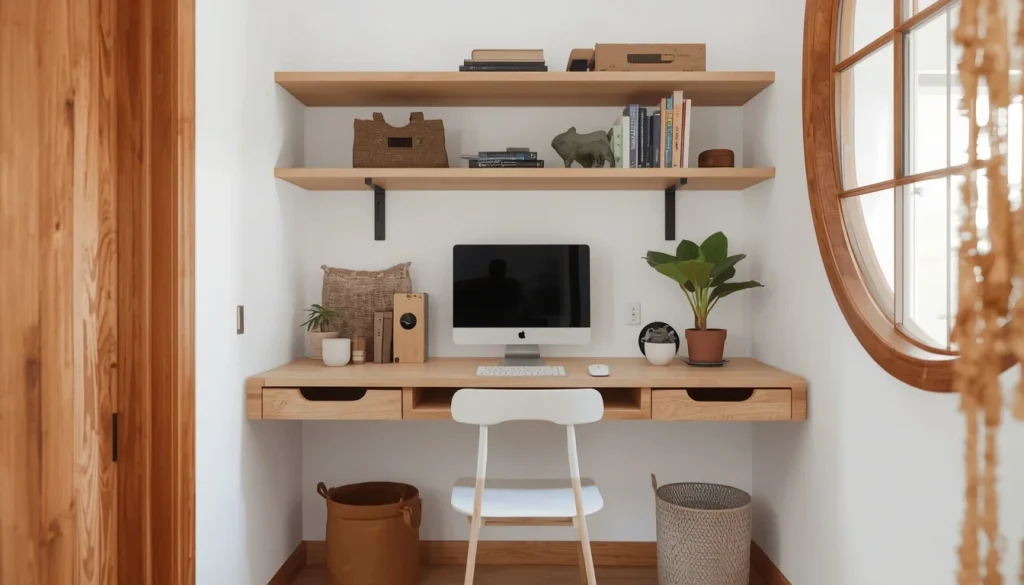
A floating desk is one of the smartest solutions for a small closet office.
Because there are no legs underneath, the space feels less crowded and you get more freedom to position your chair.
It also makes cleaning underneath easier.
Pair it with floating shelves above to create a simple vertical workstation.
4. Build a Wall-to-Wall Desktop
If your closet is narrow but reasonably wide, use the entire width.
A wall-to-wall desktop provides more usable surface area than a small desk and creates a built-in appearance.
You can place your monitor in the center while keeping notebooks, lamps, or office supplies on either side.
5. Keep the Closet Doors
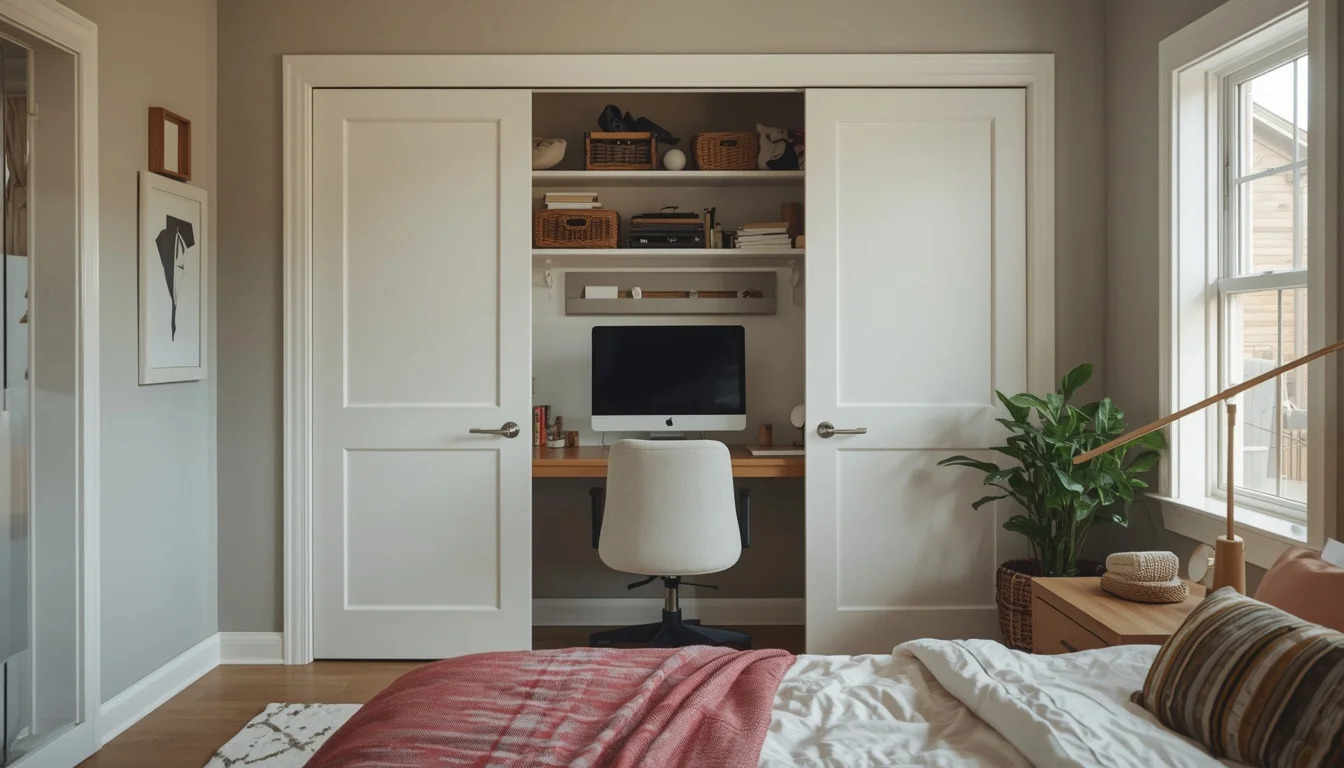
Closet doors can be one of the biggest advantages of a bedroom office.
At the end of your workday, simply close them.
Your monitor, paperwork, chargers, and office supplies disappear from view, making it easier for the bedroom to feel like a place to rest again.
This is especially useful when your bedroom is visible during most of your downtime.
6. Remove the Doors for an Open Workspace
Closet doors are not always helpful.
Traditional hinged or bifold doors can reduce elbow room or interfere with your chair.
Removing them can make a small cloffice feel more open.
If the workspace is always visible, coordinate the desk, shelving, and wall colors with the rest of your bedroom so it feels intentional.
7. Replace Doors With Curtains
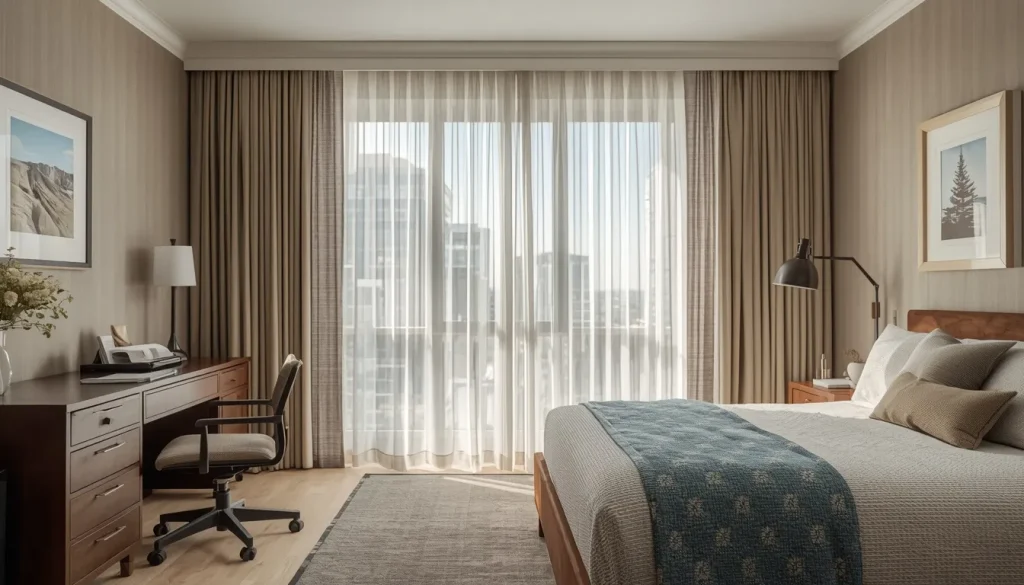
Want to hide your office without dealing with bulky doors?
Try a curtain.
It takes up very little space and can soften the transition between the office and bedroom.
A curtain is also easier to change if you redecorate later.
8. Use Sliding or Bifold Doors
Sliding doors work well when there is not enough room for traditional doors to swing outward.
Bifold doors can also work, although you need to check whether they block part of the desk opening when folded.
Always test the available chair and door clearance before deciding.
9. Add Shelves Above the Desk
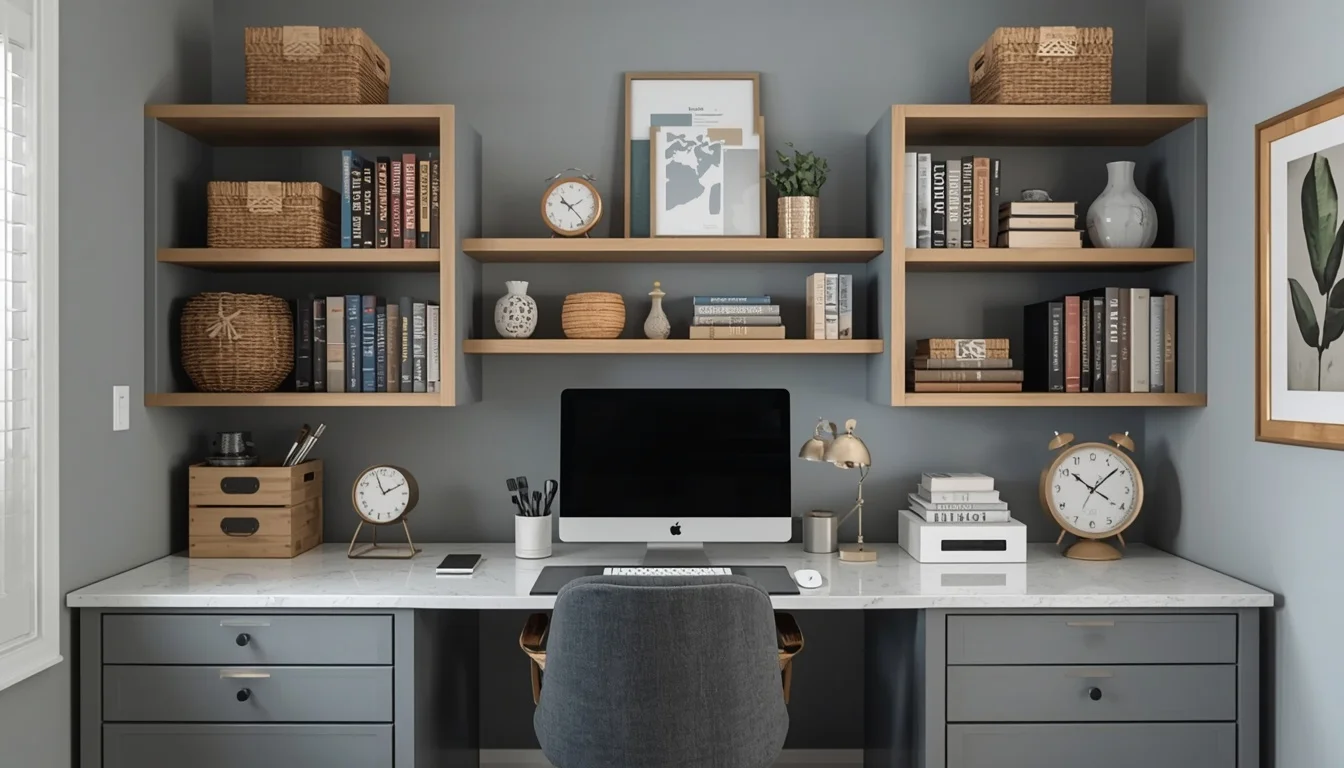
Closet offices usually have more vertical space than floor space, so use the walls.
Shelves above the desk can hold:
- Books
- Storage boxes
- Documents
- Small baskets
- Office supplies
- Decorative objects
Keep items you use every day within easy reach and place less-used items higher up.
10. Combine Clothing Storage and an Office
You do not have to choose between having clothes and having a desk.
In a wide closet, put the workspace on one side and retain hanging storage on the other.
Another option is to place the desk below upper shelving and use nearby drawers or cabinets for folded clothing.
The goal is to create clear zones so work items and clothing do not become mixed together.
11. Create a Minimalist Cloffice
Small spaces usually look better when there is less visual clutter.
Try a simple setup with:
- One desk
- One comfortable chair
- A monitor or laptop
- One task light
- Two or three shelves
- Closed storage for smaller items
Keeping the color palette simple can also help the closet feel larger.
12. Design a Cozy Closet Office
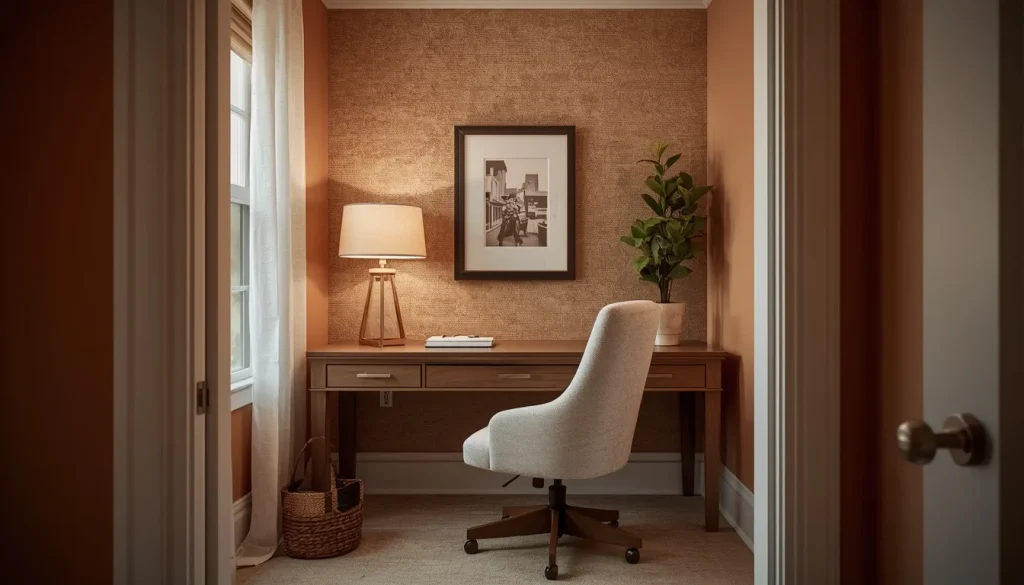
A home office does not need to feel corporate.
A warm paint color, textured wall treatment, small framed print, comfortable chair, or soft task light can make the space feel much more inviting.
Because the area is small, a few details usually have more impact than lots of decoration.
13. Choose a Built-In Closet Office
If you own your home and want a permanent solution, built-in cabinetry can make a closet office look like part of the original room.
Custom built-ins can include:
- Drawers
- File storage
- Integrated lighting
- Hidden power outlets
- Monitor space
- Adjustable shelves
- Closed cabinets
It costs more than a simple DIY setup, but the result can feel much more polished.
14. Add Wallpaper or an Accent Wall
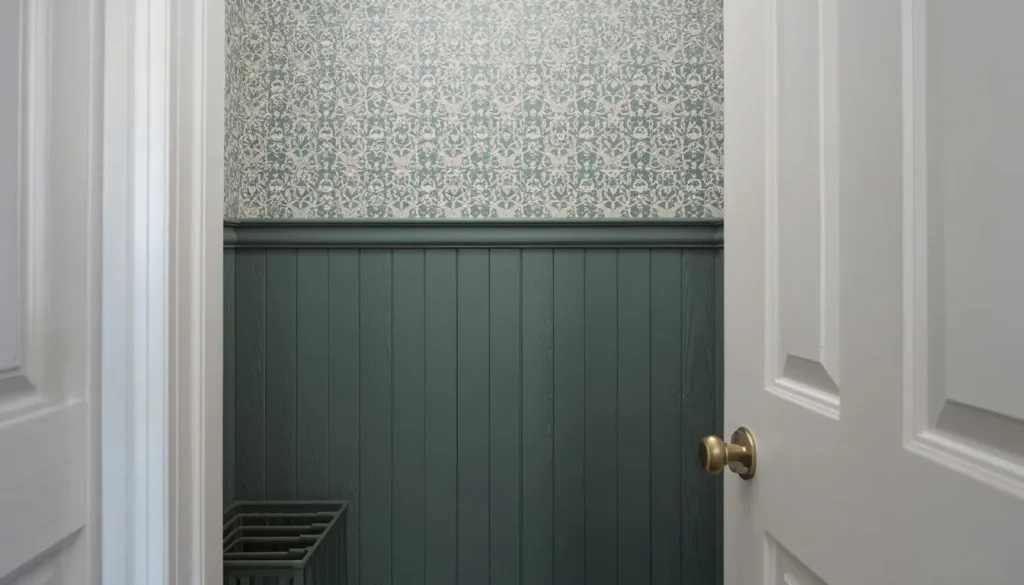
The back wall of a closet is an easy place to experiment with pattern or color.
Try:
- Removable wallpaper
- Painted paneling
- A contrasting paint color
- Wood-effect panels
- Simple geometric patterns
Because the area is small, you can create a noticeable design feature without changing the entire bedroom.
15. Install Under-Shelf Lighting
If you have a shelf directly above the desk, use the underside for lighting.
An LED strip or slim under-cabinet light can illuminate the work surface without using valuable desk space.
Choose lighting that is bright enough for work but not so harsh that it makes the bedroom uncomfortable at night.
16. Use a Pegboard for Small Supplies
A pegboard can turn an unused wall into flexible storage.
Use it for:
- Scissors
- Headphones
- Notes
- Charging cables
- Small containers
- Stationery
- Craft supplies
It works particularly well when the desk itself is too small for organizers.
17. Create a Renter-Friendly Closet Office
Renters can create an effective closet office without permanent construction.
Use:
- A freestanding desk
- Tension-rod storage
- Removable wallpaper
- Adhesive cable clips
- Plug-in lights
- Freestanding shelves
- Storage carts
Keep any original closet shelves, rods, doors, and hardware so the space can be restored later.
18. Build a Budget-Friendly DIY Cloffice
A useful closet office does not require expensive cabinetry.
A simple desktop board secured correctly to wall supports can create the main work surface. Add affordable shelves above and reuse storage containers you already own.
Spend money first on the things that affect comfort:
- A suitable chair
- Good lighting
- A stable desk
- Proper computer positioning
Decor can come later.
19. Try an IKEA-Style Closet Office Hack
Modular furniture can make building a closet office much easier.
Instead of custom cabinetry, combine a ready-made desktop with drawer units, shelves, cabinets, or storage cubes that fit your available dimensions.
Measure carefully before buying. Even a difference of an inch or two can matter inside a closet.
20. Create Hidden Storage Around the Desk
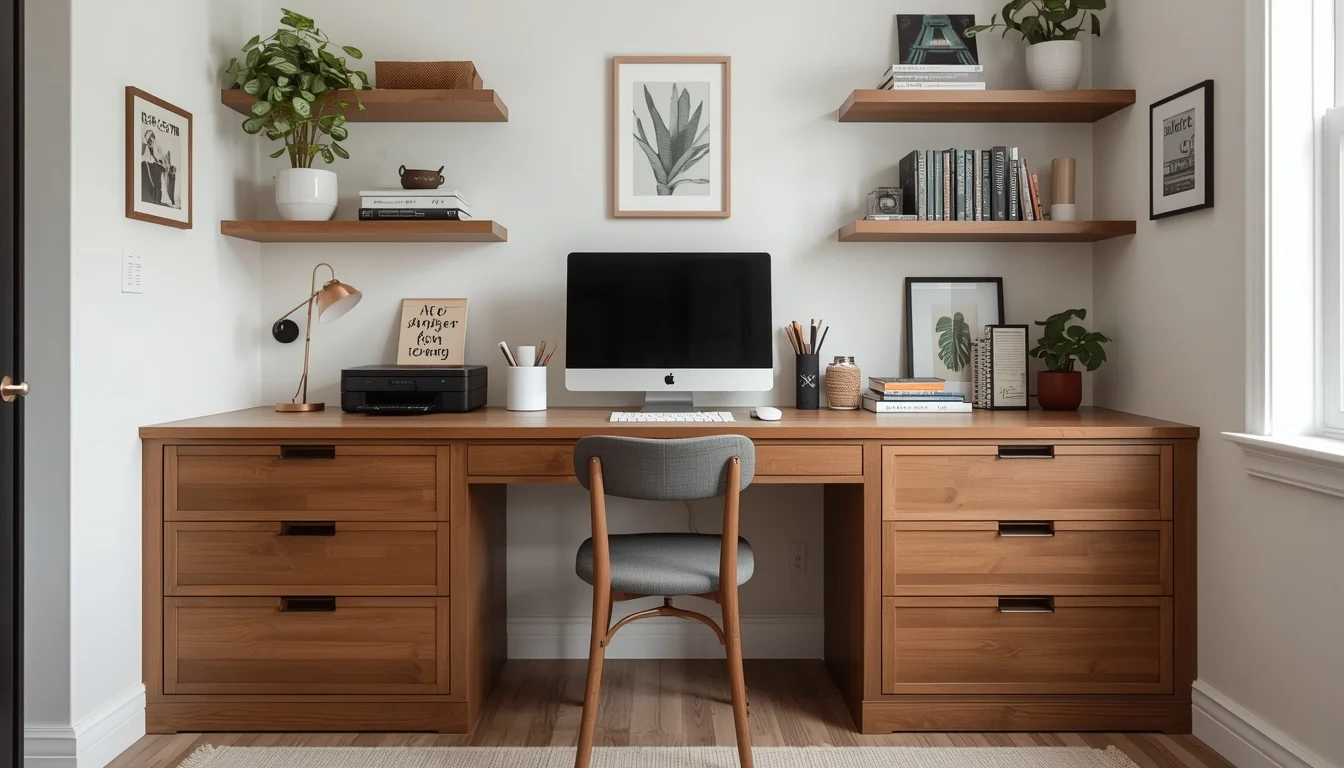
A tidy desk makes a tiny workspace feel much larger.
Use drawers or closed cabinets for items that tend to create clutter, such as:
- Chargers
- Spare cables
- Paper
- Printer supplies
- Stationery
- Documents
- External drives
Open shelving can then be reserved for items you actually want to see.
21. Create a Dual-Purpose Vanity and Office
If bedroom space is extremely limited, the closet desk can serve two purposes.
A wall-mounted mirror can turn the workstation into a vanity when the computer is put away.
Use drawers or divided storage so cosmetics and office supplies remain separate.
Best Desk Types for a Bedroom Closet Office
The right desk depends more on your closet dimensions than on style.
Wall-to-Wall Floating Desk
Best for small reach-in closets.
It uses the full width of the space and keeps the floor clear.
Fold-Down Desk
A fold-down desk is helpful when the closet must continue serving another purpose.
Fold it away when you are finished working.
This can also be a useful solution for occasional home-office use.
Compact Freestanding Desk
Renters may prefer a small freestanding desk because it requires little or no permanent installation.
Look for narrow designs without bulky side panels.
Built-In Desk
Built-in desks work well for homeowners who want a permanent, finished appearance.
They can be designed around awkward corners, outlets, shelves, and existing closet dimensions.
Sit-Stand Desk
A height-adjustable desk can work in a larger closet, but measure carefully.
Make sure upper shelves will not block the monitor when the desk is raised.
Bedroom Closet Office Dimensions and Ergonomics
There is no single perfect closet-office size. What matters is whether your body, chair, desk, and equipment fit comfortably together.
As a general planning guide:
| Element | Practical Starting Point |
|---|---|
| Desk height | Around 28–30 inches |
| Laptop desk depth | Around 20–24 inches |
| Monitor desk depth | Around 24–30 inches when space allows |
| Desk width | Around 36 inches minimum for a basic setup |
| Comfortable desk width | 48 inches or more when available |
| Knee space | Keep the area below the desk open and unobstructed |
| Monitor position | Top of screen near eye level |
| Chair space | Enough room to sit, turn, and pull back comfortably |
These measurements are starting points rather than strict rules. Your height, equipment, chair, and work habits should determine the final setup.
Do Not Make the Desk Too Deep
More desk depth is not always better.
A very deep desk can push your chair too far into the bedroom or make it impossible to close the closet doors.
For a simple laptop setup, a shallower desk may be perfectly comfortable.
Check Your Monitor Distance
If you use a large monitor, avoid placing it so close that you constantly lean backward.
A monitor arm can help because it frees desk space and gives you more control over screen position.
Leave Space for Your Chair
This is one of the easiest details to forget.
Make sure the chair:
- Fits beneath the desk
- Does not hit drawers
- Can move backward
- Does not block closet doors
- Can stay inside the closet if you want to close it
Slim or armless task chairs are often easier to use in small cloffice setups.
How to Set Up Computers and Tech in a Closet Office
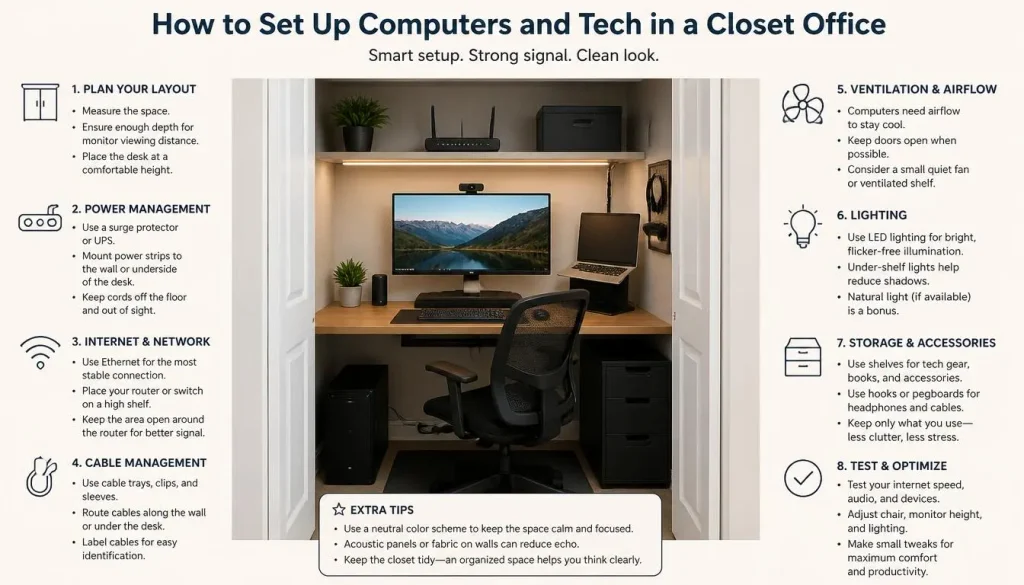
Technology can quickly take over a small desk, so choose equipment based on the space available.
Laptop-Only Setup
A laptop is ideal for very shallow closets.
Add a laptop stand, separate keyboard, and mouse if you work there for long periods.
Single-Monitor Setup
A single monitor provides more screen space without overwhelming a small desk.
Consider mounting it on an adjustable monitor arm.
Dual-Monitor Closet Office
Dual monitors are possible, but width and depth become much more important.
Before buying equipment, measure the combined monitor width and check whether the screens will sit at a comfortable viewing distance.
Two smaller monitors may fit better than two oversized displays.
Find a Home for the Printer
Printers take up valuable desk space.
If you do not use yours frequently, place it:
- On a lower shelf
- Inside a cabinet
- On a nearby storage cart
- On a shelf beside the desk
Hide the Cables
Cable clutter is especially noticeable in a small office.
Use cable trays, clips, sleeves, or an under-desk basket to organize:
- Power strips
- Laptop chargers
- Monitor cables
- USB cables
- Phone chargers
Avoid placing loose cables where your feet or chair can catch them.
How to Add Enough Lighting to a Closet Office
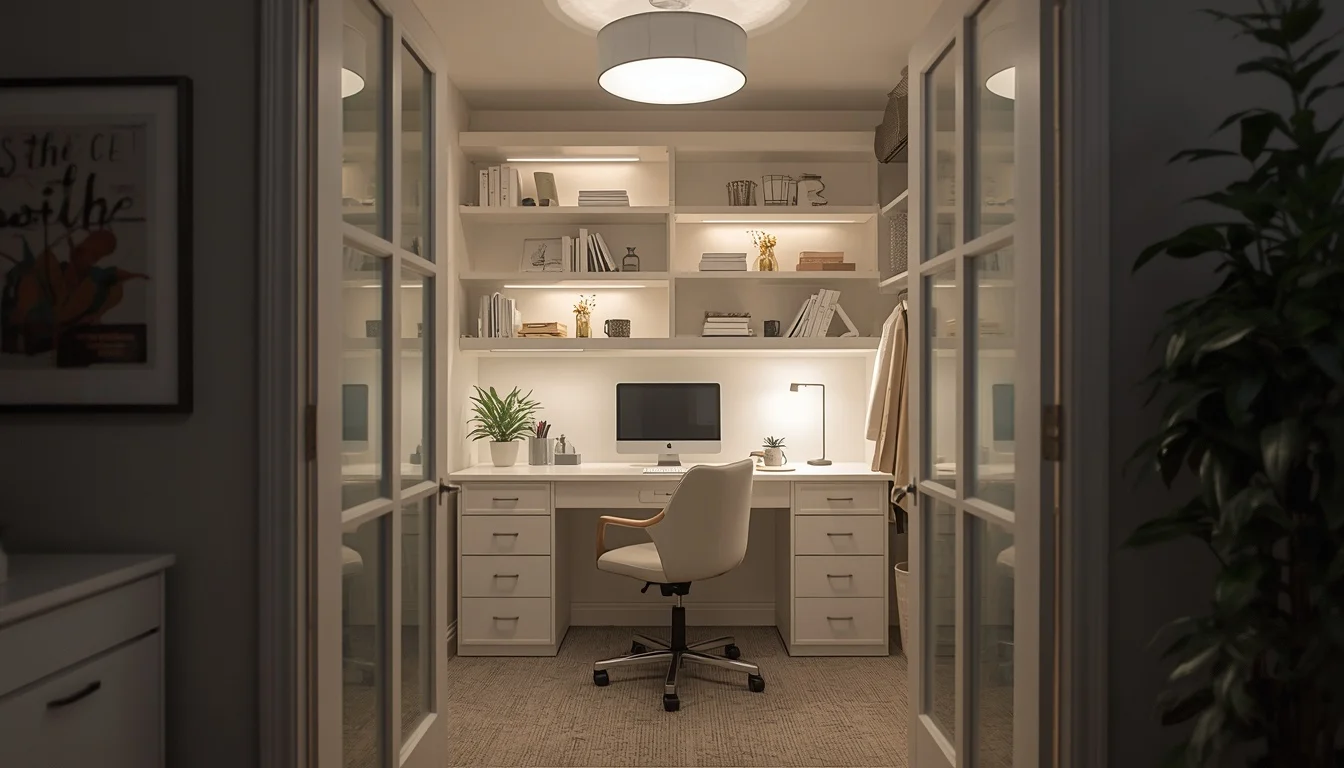
Lighting is one of the most important parts of a successful closet office.
A dark workspace can quickly become tiring.
Use Under-Shelf LEDs
LED strips or under-cabinet lights are useful because they illuminate the desk without taking up workspace.
Add a Wall-Mounted Task Light
A wall-mounted lamp is another good option when the desk is small.
Adjustable designs allow you to direct light where you need it.
Use a Compact Desk Lamp
If there is enough room, a small desk lamp gives you flexibility and can make the workspace feel more comfortable.
Make a Windowless Closet Feel Brighter
If your closet has no natural light, try:
- Light-colored walls
- A pale desktop
- A mirror
- Layered lighting
- Warm-white task lighting
Avoid relying on a single dim ceiling bulb.
How to Keep a Bedroom Closet Office Cool and Comfortable
Closets were designed primarily for storage, not for people sitting beside computers for hours.
That makes airflow important.
Keep the Door Open While Working
If your closet has solid doors, keeping them open while you work can improve airflow considerably.
Use a Small Quiet Fan
A compact fan can help in a warm, windowless closet.
Position it so it moves air through the space rather than blowing directly into your face all day.
Do Not Block Existing Vents
If there is an air vent nearby, make sure furniture, boxes, or clothing do not cover it.
Manage Heat-Producing Electronics
Desktop computers, multiple monitors, chargers, and powerful lighting can produce heat.
Keeping unnecessary equipment switched off can make a surprisingly noticeable difference in a very small workspace.
Smart Storage Ideas for a Bedroom Closet Office
The best closet office storage uses vertical space without making the desk feel boxed in.
Useful options include:
Floating Shelves
Good for books, baskets, and decorative items.
Closed Cabinets
Best for hiding paperwork, supplies, and visual clutter.
Drawer Units
Useful for stationery and small equipment.
Pegboards
Perfect for items you want within reach.
Magazine Files
An easy way to organize documents vertically.
Under-Desk Storage
Small drawers can work well here, as long as they do not reduce your legroom.
Hidden Printer Storage
Keep bulky equipment out of sight when it is not being used.
How to Combine a Closet Office and Clothing Storage
For many people, losing an entire bedroom closet is not realistic.
A hybrid setup can give you both.
Keep Clothing on One Side
In a wide closet, dedicate one half to the office and the other half to hanging clothing.
Keep Upper Storage
Your desk usually occupies the lower part of the closet, leaving valuable space above.
Use upper shelves for:
- Seasonal clothes
- Bedding
- Storage bins
- Luggage
- Less frequently used items
Separate Work Items From Clothes
Use separate shelves, drawers, or baskets so paperwork does not disappear between clothing.
Clear zones make a mixed-use closet much easier to maintain.
How to Make a Closet Office Look Good in the Bedroom
An open closet office becomes part of the bedroom decor, so treat it that way.
Match the Bedroom Colors
You do not need to use exactly the same color everywhere, but the workspace should feel connected to the room.
Limit the Number of Materials
A small area can quickly look busy.
Try repeating two or three materials or finishes rather than using a different style for the desk, shelves, chair, cabinets, and accessories.
Hide Everyday Clutter
Pens, cables, paperwork, chargers, and notebooks can make even a beautiful office look messy.
Use closed storage for things you do not need to see.
Keep Decoration Simple
One piece of art, a small plant, or a few books may be enough.
Remember that every decorative object takes space away from something functional.
How to Separate Work and Sleep in a Bedroom Office
Working in the bedroom can make it harder to mentally switch off at the end of the day.
A closet office has one major advantage: it creates a defined work zone.
If possible:
- Keep work equipment inside the closet
- Close the doors after work
- Avoid moving work to the bed
- Put paperwork away at the end of the day
- Turn off office lighting when work is finished
- Keep your bedroom nightstand free of work items
Even a small visual boundary can make your bedroom feel less like an office after working hours.
How to Make a Closet Office Work for Video Calls
A closet office can work surprisingly well for Zoom, Teams, and other video meetings if you plan the camera position.
Raise the Camera to Eye Level
Avoid placing your laptop flat on a low desk during calls.
A laptop stand or monitor-mounted webcam can create a much more natural camera angle.
Add Light in Front of You
Do not rely entirely on an overhead light.
A small light positioned near or behind the monitor can make your face easier to see.
Check What Is Behind You
If the camera faces into the bedroom, remove obvious clutter from the frame.
If it faces the inside of the closet, use a simple wall, shelf, or neutral background.
Reduce Echo
Closets with hard walls and empty surfaces may sound slightly hollow.
Books, fabric storage boxes, curtains, rugs, and other soft materials can help absorb some sound.
Bedroom Closet Office Ideas on a Budget
A closet office can be one of the more affordable ways to create a dedicated workspace because three walls already exist.
You may only need a desk surface, chair, lighting, and storage.
To keep costs under control:
- Reuse existing shelves
- Buy a basic desktop instead of custom cabinetry
- Use wall-mounted brackets
- Choose plug-in lighting
- Reuse storage baskets
- Shop for a second-hand office chair
- Paint instead of adding expensive wall treatments
- Add decorative upgrades gradually
Prioritize comfort before appearance. A good chair and usable desk will matter much more after three hours of work than expensive wallpaper.
DIY vs Semi-Custom vs Built-In
| Setup | Best For | Typical Approach |
|---|---|---|
| DIY | Tight budgets | Simple desk, shelves, plug-in lighting |
| Semi-custom | Everyday home working | Modular cabinets, quality desktop, better storage |
| Custom built-in | Permanent office | Fitted cabinetry, integrated lighting and storage |
The final cost will vary widely depending on materials, labor rates, electrical work, cabinetry, and location.
Renter-Friendly Bedroom Closet Office Ideas
Renters should focus on changes that can be reversed easily.
Good options include:
- Freestanding desks
- Narrow console desks
- Removable wallpaper
- Adhesive cable organizers
- Plug-in wall lights
- Freestanding shelves
- Rolling drawer units
- Storage carts
Avoid removing permanent shelving or drilling into surfaces unless your rental agreement allows it.
If you remove closet rods or doors, label the hardware and store everything safely so it can be reinstalled later.
How to Turn a Bedroom Closet Into an Office Step by Step
If you are ready to build rather than just gather inspiration, use this order.
Step 1: Empty the Closet
Remove clothes, boxes, shelves, and anything else that prevents you from seeing the full space.
Step 2: Measure Everything
Record the width, depth, height, door clearance, outlet locations, and available chair space.
Step 3: Decide What Storage Must Stay
Plan alternative clothing storage before removing useful closet features.
Step 4: Choose the Desk Position
Decide how deep and wide the desk can be without making the workspace uncomfortable.
Step 5: Plan Electrical and Cable Access
Know where your laptop, monitor, lighting, and charging cables will go.
For new permanent electrical work, use a qualified professional and follow local electrical requirements.
Step 6: Install the Desk
Make sure the work surface is stable and properly supported.
Step 7: Add Shelving and Storage
Build upward rather than filling valuable floor space.
Step 8: Install Lighting
Test the lighting while sitting at the desk, not just while standing in the room.
Step 9: Position Your Computer
Adjust the monitor, keyboard, mouse, and chair so you can work without constantly leaning forward or looking down.
Step 10: Add Decoration Last
Once the functional pieces are working, finish the space with paint, art, wallpaper, or accessories.
Common Bedroom Closet Office Mistakes to Avoid
A few mistakes can turn a clever idea into an uncomfortable workspace.
Making the Desk Too Deep
A deep desk may leave no room for your chair.
Ignoring Chair Clearance
Measure the space while imagining someone actually sitting there.
Forgetting About Power
Do not finish the desk only to discover that the closest outlet is across the bedroom.
Installing Shelves Too Low
Shelves above the monitor can make the workspace feel cramped and may limit future screen upgrades.
Using an Oversized Chair
A large executive chair rarely works well inside a small reach-in closet.
Ignoring Ventilation
Closets can become uncomfortable once electronics start producing heat.
Filling Every Wall With Storage
Vertical storage is useful, but too many shelves can make a tiny workspace feel claustrophobic.
Forgetting Cable Management
Plan where cables will travel before installing a wall-to-wall desk.
Sacrificing Too Much Clothing Storage
Make sure you have somewhere else to put the things that previously lived in the closet.
Is a Bedroom Closet Office Right for You?
A cloffice is not the perfect solution for every home.
| Advantages | Possible Drawbacks |
|---|---|
| Saves bedroom floor space | Reduces closet storage |
| Creates a defined work area | May lack natural light |
| Can be hidden behind doors | Small spaces can feel warm |
| Works well in apartments | Large office chairs may not fit |
| Makes use of underused space | Electrical access may need planning |
| Can be inexpensive to build | Not ideal for large equipment setups |
A closet office is usually a strong choice if your main priority is having a dedicated workspace without adding another large piece of furniture to the bedroom.
Frequently Asked Questions About Bedroom Closet Offices
Can You Turn a Bedroom Closet Into an Office?
Yes. Many reach-in, walk-in, and wardrobe-style closets can be converted into compact offices. The main things to check are desk depth, chair clearance, electrical access, lighting, ventilation, and how much clothing storage you are willing to give up.
What Is a Closet Office Called?
A closet office is commonly called a cloffice, a word created by combining “closet” and “office.” In the UK, Australia, and other markets, similar spaces may also be described as wardrobe offices or built-in wardrobe desks.
How Deep Should a Closet Be for an Office?
There is no single required depth. A shallow closet may work for a laptop and compact desk, while a full monitor setup usually benefits from more depth. Always account for both the desk and the space required to sit comfortably in front of it.
Can a Small Reach-In Closet Become an Office?
Yes. A reach-in closet is often ideal for a simple laptop workstation. A floating desk, slim chair, task lighting, and shelves above the desk can create a complete office without using much floor space.
Should I Remove the Closet Doors?
Only if they interfere with the chair or desk.
Keeping the doors allows you to hide your workspace after work. Removing them makes the office feel more open. Curtains or sliding doors offer a middle ground.
Can a Closet Office Still Hold Clothes?
Yes. Use one side of a wide closet for clothing, keep shelves above the desk, or combine nearby drawers and hanging space with the office area.
How Do You Light an Office Inside a Closet?
Under-shelf LEDs, wall-mounted task lights, compact desk lamps, and existing ceiling lighting can all work. For windowless closets, using more than one light source usually creates a more comfortable workspace.
Can You Put Two Monitors in a Closet Office?
Yes, provided the closet is wide and deep enough. Measure the monitors before choosing your desk and consider using monitor arms to save workspace.
How Do You Keep a Closet Office From Getting Too Hot?
Keep the doors open while working, maintain airflow, use a small quiet fan when appropriate, avoid blocking vents, and switch off unnecessary electronics.
What Is the Best Desk for a Closet Office?
For most small closets, a floating wall-to-wall desk is one of the most space-efficient choices. Renters may prefer a compact freestanding desk, while larger closets can accommodate built-in or adjustable desks.
How Can I Create a Closet Office Without Drilling?
Use a freestanding desk, modular shelves, rolling drawers, plug-in lighting, removable wallpaper, and adhesive cable clips. This approach works well for rental homes.
How Can I Hide an Office in a Bedroom?
A closet is one of the easiest ways to create a hidden bedroom office. Keep the original doors, install sliding doors, or add a curtain so the entire workspace can disappear when the workday ends.
Final Thoughts
The best bedroom closet office ideas are not necessarily the most elaborate ones. They are the setups that make good use of a small area while still giving you enough room to sit, work, store your essentials, and switch off when the day is finished.
For a very small closet, start with a floating desk, compact chair, task light, and a few shelves.
If you still need clothing storage, build a hybrid wardrobe office with the desk on one side and clothing on the other.
If the workspace will be used every day and you plan to stay in the home long term, custom built-ins can provide a more polished solution.
Whatever approach you choose, measure first. Desk depth, monitor position, chair clearance, lighting, ventilation, power access, and storage will have a much bigger impact on how much you enjoy the space than decoration alone.
A closet may look too small to matter now, but with the right layout, it can become one of the most useful corners of your bedroom.

“A comfortable home and a healthy lifestyle go hand in hand.”
Hi, I’m Ethan Carter, the founder and lead editor of TheBestHomeFit. I’m passionate about helping people create beautiful, functional living spaces while building healthier lifestyles at home. Over the years, I’ve spent countless hours researching home decor trends, testing home gym equipment, and reviewing products to help readers make smarter buying decisions.
Through TheBestHomeFit, I share practical home improvement ideas, honest product reviews, buying guides, and fitness tips designed for everyday homeowners. My goal is to make it easier for you to create a home that looks great, feels comfortable, and supports your well-being.
When I’m not researching the latest products or writing in-depth guides, you’ll usually find me redesigning a room, trying new home workout routines, or enjoying quality time with my family.